
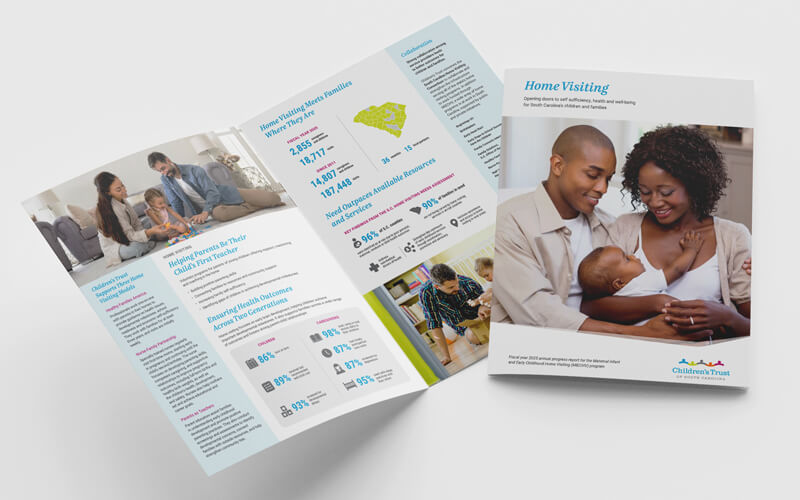
Children’s Trust has published its Fiscal Year 2025 Annual Progress Report (PDF) for the federal Maternal, infant and Early Childhood Home Visiting (MIECHV) program. Children’s Trust administers this federal investment in home visiting for South Carolina home visiting programs and regularly meets and exceeds our federal funding benchmarks.
Home visiting programs are voluntary services that bring trained professionals directly into the homes of families with young children. Rather than waiting for families to come to a clinic or office, home visitors meet families in their homes, seeing the family’s context of their daily lives, including their challenges and their successes.
“Most eligible families are navigating specific risk factors, like poverty, social isolation, first-time parenthood, or other issues that can make raising a child especially challenging,” said Cathy Ramage, director of home visiting. “Home visitors help parents understand child development, build nurturing routines, connect with community resources, and develop the confidence and skills they need to be their child’s first and most important teacher.” Visits can be weekly, especially early on, and relationships with families typically last one to three years.
Home Visiting Prevents Child Abuse and Neglect
Child maltreatment often does not have a single cause. Rather, it emerges from a series of risk factors that create pressures on families: economic hardships, housing insecurity, untreated mental health challenges, lack of social support, and gaps in knowledge about child development. When those pressures build without relief, the risk to children grows. Home visiting works to alleviate those underlying conditions head-on, long before a crisis occurs.
Home visitors are trained professionals who help parents develop positive parenting skills, connect families to resources and community supports, increase family self-sufficiency, and identify gaps in children’s achievement of developmental milestones. These voluntary programs for parents with young children provide support, mentoring, and coaching in the home.
Evidence-based home visiting programs are proven to lower child abuse and neglect rates, reduce emergency department visits, enhance children’s cognitive and social development, and boost maternal economic self-sufficiency. These benefits are long-term, providing lasting positive impacts throughout the child’s life.
“When families receive consistent, compassionate support in their own homes, children are safer, and families are stronger,” Ramage said. “Prevention is not an abstract concept. Rather, it happens visit by visit through genuine, caring relationships.”
Working Across Two Generations
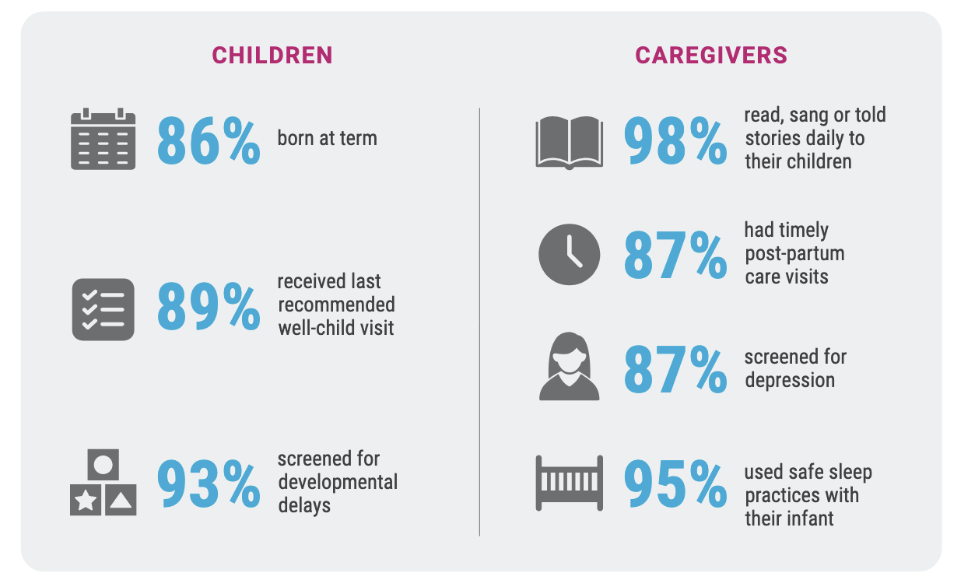
The FY25 Annual Progress Report demonstrates positive results for children and caregivers participating in South Carolina’s home visiting programs.
Why Evaluation and Data are Important
Children’s Trust only implements evidence-based programs, which means the program models are carefully evaluated and have been shown to be effective in peer-reviewed studies, producing positive results in child development, maternal health, and more. Continuous data collection and regular evaluation are crucial to ensure that programs are delivered with fidelity and that the investment in programs achieves its intended outcomes.
Children’s Trust and our program partners collect and analyze data across a wide range of benchmark measures, including child health outcomes, developmental screening rates, safe sleep practices, caregiver mental health, and more. These benchmarks enable us to compare our performance to expectations, identify where programs excel, and to direct support and technical assistance to areas that may need improvement.
The Need is Greater Than What We Can Currently Meet
Program evaluation clearly shows that home visiting is effective and requires more investment. However, demand exceeds our funding capacity to deliver services. The FY25 report documents both the program’s impact and the extent of the unmet need in South Carolina. 96% of counties have been identified as “at-risk” due to poor prenatal, maternal, newborn, or child health outcomes. Nine out of ten families in those at-risk counties who need services are not receiving home visiting support. These significant gaps highlight the urgent need for increased investment and advocacy.
At Work Across South Carolina
Children’s Trust funds three evidence-based, home visiting models as part of the MIECHV program:
- Healthy Families America. Professionals work one-on-one with parents to provide guidance on health, developmental milestones, school readiness, and economic self-sufficiency. Families are served for at least three years, with visits beginning weekly.
- Nurse-Family Partnership. Specially trained nurses visit first-time mothers beginning early in pregnancy and continuing until the child’s second birthday. Nurses focus on healthy birth outcomes, safe infant care, parenting competence, and helping mothers set and achieve educational and career goals.
- Parents as Teachers. Parent educators help families understand early childhood development, promote positive parenting practices, conduct developmental screenings, and strengthen connections to community support.
Children’s Trust also brings together the S.C. Home Visiting Consortium to collaborate and strengthen the infrastructure that supports all of the state’s home visiting programs. We also oversee workforce development for home visiting in the state by hosting the Home Visiting Summit and the Hope Conference for Children, along with providing additional quality professional development opportunities.
Maternal, Infant, and Early Childhood Home Visiting is a program of Children’s Trust of South Carolina and is supported by the Health Resources and Services Administration (HRSA) of the U.S. Department of Health and Human Services (HHS) under CFDA #93.870, Grant #X10MC53648. The information or content and conclusions are those of the author and should not be construed as the official position or policy of, nor should any endorsements be inferred by HRSA, HHS, or the U.S. Government.