
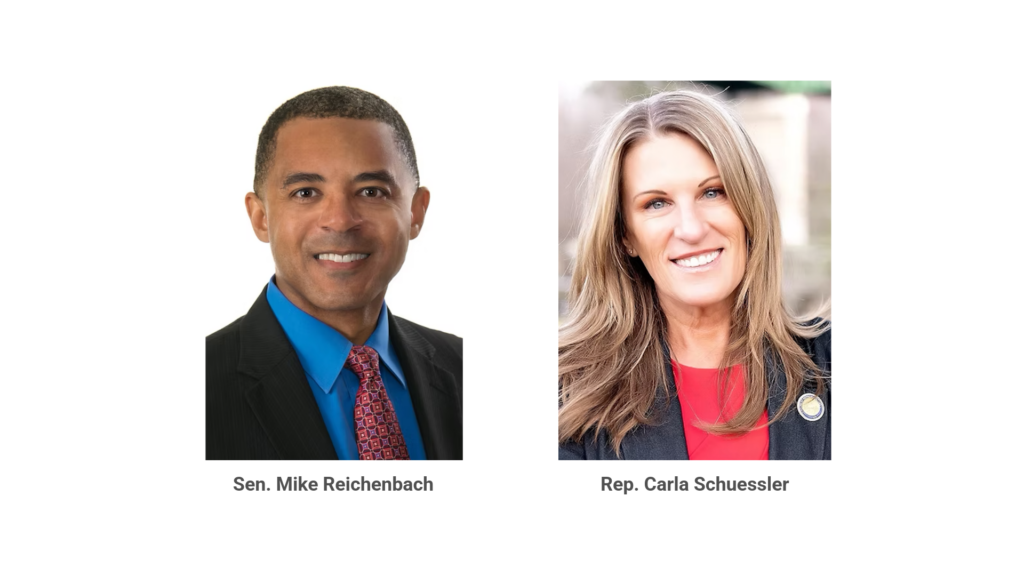
By Senator Mike Reichenbach and Representative Carla Schuessler, Joint Citizens and Legislative Committee on Children
The Fostering Futures Act is a legislative initiative supported by the Joint Citizens and Legislative Committee on Children (Committee on Children) that aims to expand access to higher education for South Carolina youth with a foster care background.
The Committee on Children is a bipartisan consortium of legislators, governor-appointed citizens, and agency leaders that studies issues affecting children in South Carolina to help inform children’s policy and legislation.
Each fall, the Committee holds hearings across the state to receive input from families, community members, organizations and service providers on emerging issues affecting children and families.
During the Committee’s 2025 fall hearings, representatives from SC FIRST presented an initiative to create a college tuition waiver for youth aging out of foster care.1 This policy idea generated strong interest among Committee members as a potential strategy to improve access to higher education for young people with a foster care background. Following the fall hearings, representatives from SC FIRST worked with the Committee to develop legislation that became the Fostering Futures Act.
“During our fall hearings, we heard compelling testimony about the barriers young people face as they transition out of foster care,” Vice-Chair Rep. Carla Schuessler said. “Expanding access to higher education is one meaningful way we can help ensure these young adults have the opportunity to build stable and successful futures.”
The Fostering Futures Act (S.824, H.5008) would require public institutions of higher education to waive tuition and required fees for certain current and former youth in South Carolina and establish eligibility criteria and program limits. If enacted, eligible individuals who have experienced foster care and are admitted to a public two- or four-year institution in South Carolina would receive a waiver of tuition and required fees.
Access to higher education can play a significant role in shaping long-term economic stability and opportunity. Research consistently links higher education attainment to stronger employment outcomes and higher lifetime earnings.2 Individuals who complete postsecondary education are more likely to obtain stable, higher-paying jobs, contribute more to the state tax base and participate more fully in the economy.
Evidence from other states also suggests that tuition waiver programs can significantly improve college outcomes for former foster youth. For example, former foster youth in Texas who used the state’s tuition waiver were 3.5 times more likely to graduate from college.3 Research also shows that college graduates rely 60–80 percent less on public assistance and other social services over their lifetimes.4
Research also highlights the long-term benefits of higher education for young people who have experienced foster care. Former foster youth who earn a college degree are 75 percent less likely to experience homelessness5 and 65 percent less likely to become involved in the criminal justice system by age 26 compared with peers who do not complete college. 6
“Too often, young people who grow up in foster care face financial barriers that make higher education feel out of reach,” said Chairman Sen. Mike Reichenbach. “Policies like the Fostering Futures Act can help ensure they have the same opportunity to pursue college and build stable, successful futures.”
“For young people transitioning out of foster care, the challenge is often not ability or motivation, but access,” Sen. Reichenbach continued. “Reducing financial barriers to higher education can make a meaningful difference in the opportunities available to them.”
How we treat children is one of the clearest indicators of our state’s future. By expanding access to higher education for young people who have experienced foster care, the Fostering Futures Act represents an opportunity to support individual success while strengthening the future of South Carolina.
Sources
1 Testimony presented by Dr. Amanda Moon, Dr. Kristen Seay, and Dr. Amanda Stafford McRell of SC FIRST. For more information, see sc4first.com.
2 U.S. Bureau of Labor Statistics (2025). Education Pays: Earnings and unemployment rates by educational attainment. U.S. Department of Labor.
3 Watt, T., & Faulkner, M. (2020). The Texas tuition and fee waiver program for youth who have experienced foster care: An assessment of waiver utilization and impact. Children and Youth Services Review, 117, 105285. https://doi.org/10.1016/j.childyouth.2020.105285.S
4The Annie E. Casey Foundation. (2019). Future Savings: The Economic Potential of Successful Transitions from Foster Care to Adulthood. https://www.aecf.org/resources/future-savings.
5 O’Neale, S. (2024). Foster Care and Homelessness. Foster Focus. https://www.fosterfocusmag.com/articles/foster-care-and-homelessness.
6 Courtney, M.E., Dworsky, A., Brown, A. Cary, C., Love, K., & Vorhies, V. (2011). Midwest evaluation of the adult functioning of former foster youth: Outcomes at age 26. Chicago, IL. Chapin Hall at the University of Chicago.