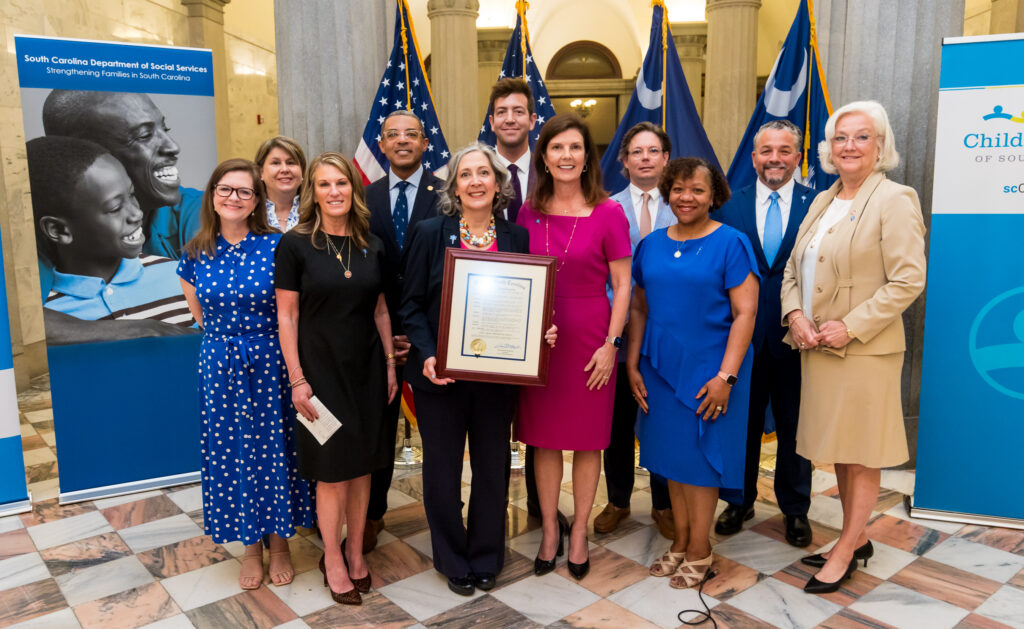

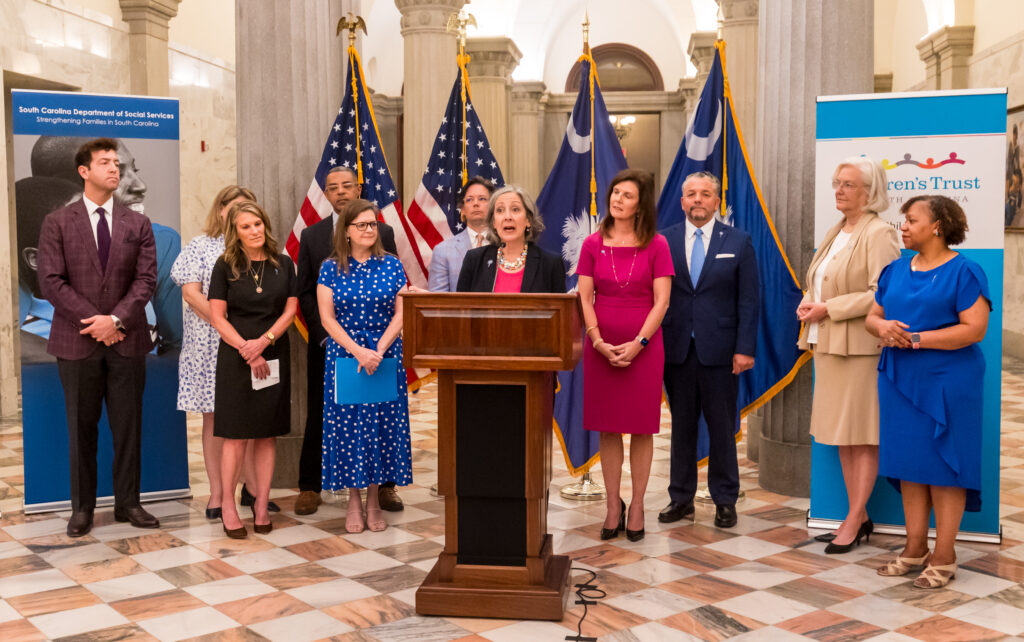
On April 2, 2026, at the South Carolina State House, state leaders and child advocates gathered to declare April as Child Abuse Prevention Month in South Carolina. What came out of that press conference was more than just a ceremonial proclamation. It was clear: Child abuse prevention is a shared commitment and must be a top priority for our state.
The Scope of the Problem
Governor Henry McMaster’s proclamation, delivered by Lt. Governor Pamela Evette, highlighted sobering figures on the challenge. In the 2024–2025 fiscal year, there were 7,024 substantiated child protective service cases involving 12,370 children across South Carolina. The proclamation emphasizes, “Childhood trauma, including abuse and neglect, is a serious problem affecting every segment of our community.”
Children’s Trust CEO Sue Williams highlighted the organization’s recent economic study, which found that even a modest reduction in the number of children experiencing abuse and neglect in South Carolina could generate $21 billion in statewide economic benefits over the next decade, while also saving the state significant costs in intervention, incarceration and lost workforce productivity. Prevention is not charity. It is sound public policy.
The Imperative for Prevention
South Carolina Department of Social Services Director Tony Catone grounded the conversation in a truism we have almost taken for granted: “An ounce of prevention is worth a pound of cure. Our grandparents taught us that. It was true when they said it, and it’s true today.”
Director Catone shared SCDSS prevention initiatives, including the Community Pathway Preparedness Procedure Program, which leverages federal financial participation to support the state’s upstream prevention efforts to strengthen children and families across the state.
Catone also emphasized the need for a “robust continuum…of conditional protective services, prevention providers and community organizations,” highlighting their support for family resource centers and other innovative approaches to expand the reach of positive parenting programs.
He added, “Families should know where to turn when challenges arise long before those challenges escalate into crisis…before they reach the end of their rope. Effective prevention requires a continuum that reduces risk factors faced by all families, offers timely support to those showing early signs of stress, and prevents recurrence.”
Families Are Telling Us What They Need
Representative Carla Schuessler, vice chair of the Joint Committee on Children, reminded the audience that the data is about real people, “It can be easy to focus on statistics, but behind every number is a child, a family and a story.” As part of the committee’s statewide listening tour this past fall, more than 270 South Carolinians shared their experiences.
“We heard from parents who are one unexpected expense away from losing stable housing. We heard from caregivers struggling to find child care they can afford. We heard from families navigating mental health challenges without access to timely support.”
These are not isolated cases. They are the everyday pressures that, without support, can escalate into crisis. Schuessler continued: “These challenges do not exist in isolation. They create stress, instability and risk within families. And when those pressures build without support, children are often the ones who feel the impact most deeply.”
The families who testified during the tour shared that when they had access to parenting guidance, mental health services, or help with basic needs, their trajectory changed. It kept families together.
Programs That Work Need Sustainable Funding
Home Visiting, the Strengthening Families Program, the Positive Parenting Program and a network of Family Resource Centers are already proving their value in communities across South Carolina. Children’s Trust now has more than 65 funded partners operating prevention programming in all 46 counties.
These are not pilot projects. They are established, evidence-based programs with demonstrated results. But as Children’s Trust CEO Sue Williams noted, “These programs need sustainable, reliable funding to reach more families across our state.”
Lt. Gov. Evette added that she and Gov. McMaster “asked the General Assembly to join us by giving $5 million to the Children’s Trust. Because we know when we stop child abuse on the front end, we make a better, happier South Carolina.”
The infrastructure is being built, and our opportunity is to fund it to scale.
Reminding Us of Our Shared Responsibility At the State House and in Our Neighborhoods
Senator Mike Reichenbach, chair of the Joint Committee on Children, offered a direct call to personal accountability, “Are we talking to our neighbors? Are we talking to young people? Are we talking to those family members that you see are struggling?” He reminded us that life can be hard and sometimes, “we have to lean into the mess of life.”
His message was that prevention cannot be delegated entirely to government programs or nonprofit workers. It requires a culture shift in which communities lean into difficulty rather than look away.
That theme was amplified by Department of Children’s Advocacy Acting Director Margaret Bodman, who spoke directly to the tendency to assume that “they,” meaning some other agency, system or person, will handle the problem. “Well, here’s the thing. You are they. No matter who you are, you can do something about child abuse.”
Bodman specified several opportunities, including offering stable relationships to children, supporting caregivers under stress, keeping communication open with youth, volunteering as a mentor, serving on a foster care review board, or becoming a foster parent.
A Story Worth Repeating is a Call for Action
Lt. Governor Evette offered a story that captured what prevention looks like at its best. She described meeting a young mother who had been referred to the Nurse-Family Partnership Program by her doctor. Through that program, the mother connected with a nurse partner, who helped her access a range of support, including a workforce scholarship.
The mom eventually earned a degree in human resources from Greenville Technical College and built a stable life for herself and her daughter. “[The program] took a mom, and it broke the cycle of poverty. It made her proud to be the mom that she wanted to be for her daughter.”
Board Chair Philip Vann noted that Children’s Trust was established more than 40 years ago to put the science of prevention to work in South Carolina. Prevention science has only grown stronger since then. What remains is the will to act on it consistently and at scale.
Sue Williams closed the morning with a clear-eyed observation: “Children cannot vote. They cannot lobby. They cannot show up at a budget hearing and make the case. That is our job.”