
The assistant secretary for the Administration for Children and Families (ACF), Alex J. Adams, was a headlining speaker at the recent Building Hope for Children Conference. His determination to be a voice in our conversation was evident in his very presence: he had persisted in attending the event despite having recently undergone ACL surgery.
Adams, a former child welfare official, began by describing his early observations of ACF’s reform efforts. He had noted that new solutions often added systematic burdens: new forms, new reports, new requirements. Adams stated that his desire was to renew ACF altogether, with the Home for Every Child campaign being a major element of this effort.
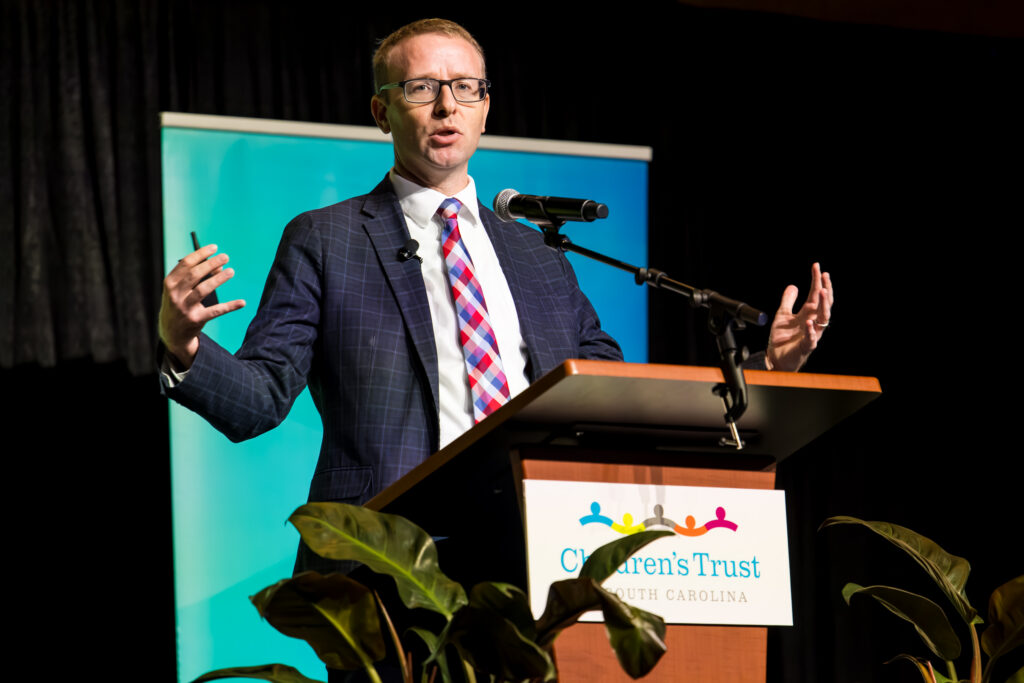
Adams described his journey from state budget director to assistant secretary of ACF and how it eventually led to the Home for Every Child initiative.
“I had the snark and cynicism of probably your state budget director, and I was relatively new to human services,” Adams recalled. “The governor asked me to run [the Idaho Department of Health and Welfare] in June of 2024. So as I was transitioning from budget, I did what I would like to think most new directors do. They sit down with their predecessors. They sit down with legislators. They sit down with key constituencies.
“In Idaho, HHS is an umbrella agency. We have child welfare, Medicaid, SNAP, TANF, childcare, everything down to the regulation of public swimming pools. So you get pulled in a lot of directions. And the quote I remember most from one of my predecessors is, ‘Alex, at HHS, 86% of my budget is Medicaid, but 86% of my headaches are child welfare.’ And when I started at HHS, we were a system that was bursting at the seams.”
Adams elaborated, explaining that Idaho has fewer kids in foster care, yet the state lacks homes to keep them. He then posed a question as to why the number of children in foster care keeps reducing but the cost keeps rising.
Being new to the field of foster care, “I spent quite a bit of time listening to lived experts, current former foster youth, current former foster parents, and bio parents who had direct experience with the child welfare system,” Adams stated. “And everything felt urgent and pressing. Knowing where to start was a struggle.”
He hoped to diagnose the issue and emphasized the need to return to a basic initial question: How does a kid end up in a state child welfare system?
Adams stated that there are three factors driving the child welfare budget. First is what he calls the front door. There is a need to identify the number of children placed, and then control that number through prevention services, such as CBAP and primary prevention. The second factor is the length of stay, which he calls the backdoor. The final factor is where the child is placed. Adams noted the difference between paying $16 a day for a child in foster or kinship care and the $385 cost per day needed to cover the cost of a child in congregate care. For every ten children in kinship care as compared with congregate care, the savings amount to about $1.3 million a year.
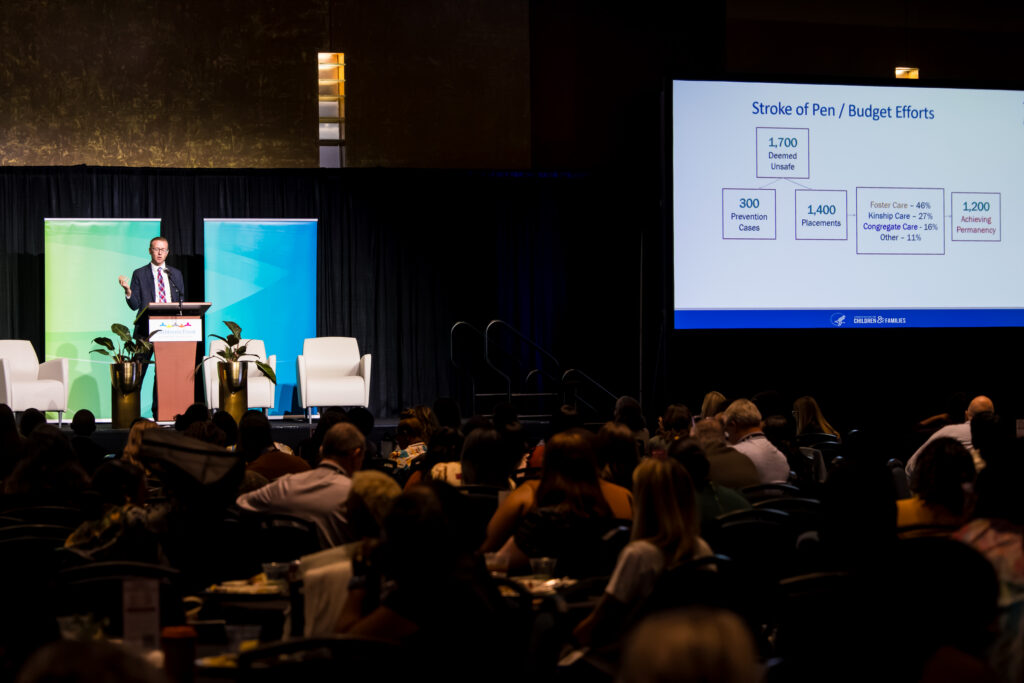
Adams emphasized the importance of prevention, the lowest-cost option. With the prevention benefits in mind, Adams described his efforts to grow Idaho HHS’s support for and innovation in prevention methods. “I wanted to show the courts that we could keep kids safely in their homes and provide appropriate oversight to them, and that removal and the trauma of entering into foster care could be avoidable,” he said.
HHS invested in improving the software that identifies the relatives of children brought to the system’s attention and in conducting background checks on kin. They also waived licensing fees for adoptive parents. These efforts made more homes available and reduced the number of children in congregate care, increasing the ratio from 74 homes per 100 children to 104 homes per 100 children. The money saved from these efforts was reinvested in prevention strategies.
When Adams was nominated to lead the Administration for Children and Families (ACF), his dream was to replicate his work in Idaho at the national level. In this new position, he has launched the Home for Every Child campaign, a pilot program in which several states provide monthly reports on the ratio of homes to kids, placement stability, kin placement rates, congregate care placement rates, and repeat maltreatment. This presents an opportunity to develop a database of child welfare data, enabling every state to evaluate its performance relative to other states and identify what is working and what is not.
The assistant secretary commended South Carolina for joining the Home for Every Child campaign and celebrated the bipartisan nature of child welfare efforts. He hopes this bipartisan support will continue.
More information about the Home for Every Child Initiative is available on the ACF website.