By Hannah Warner, Chief Public Policy & Government Relations Officer, and Benita Chukwuemeka, Community Impact Intern
This past fall, the South Carolina Legislature’s Joint Citizens and Legislative Committee on Children held a series of five public hearings across the state to give citizens the opportunity to have their voices heard on issues impacting children.
The Conway, Greenville, Charleston, Rock Hill and Columbia events were all well-attended, evidencing the public’s engagement and desire to see South Carolina become a place where all children thrive.
Members of the Children’s Trust Board of Directors testified at four of the five public hearings. With a focus on prevention efforts and evidence-based programming, board members encouraged the members of the committee to contribute to policies that support children and families.
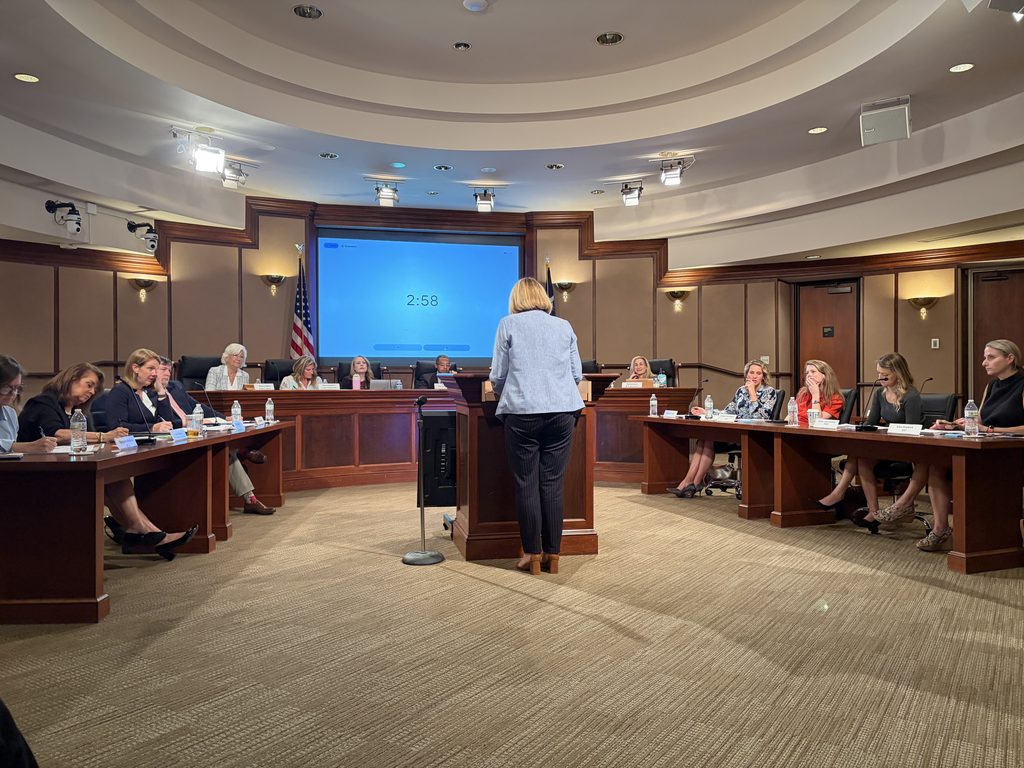
Dr. David Kahn of Florence attended the first JCLCC Fall Public Hearing in Conway. Dr. Kahn, a mental health professional, spoke to encourage members of the committee to support measures to prevent adverse childhood experiences (ACEs).
After describing the impact of ACEs on childhood development and the long-term effects of this trauma, Dr. Kahn emphasized the importance of investing in evidence-based programs like home visiting, the Strengthening Families Program, Triple P and family resource centers. He noted that investment in prevention benefits both adults and children by “breaking cycles of abuse and neglect linked to many chronic illnesses adults face.”
“Supporting today’s parents is also an investment in the parents of tomorrow,” Kahn said.
Tiffany Santagati, who testified on behalf of Children’s Trust at the Greenville JCLCC public hearing, also urged the committee to vote for prevention. Santagati, who has spent the majority of her career in the banking industry, focused on the economic impact of child abuse and neglect. A recent study, conducted at the University of South Carolina’s Darla Moore School of Business, revealed that ACEs cost the state about $74.2 billion annually in economic losses. The study also revealed that investing in prevention efforts and reducing ACEs could save the state about $21 billion over ten years.
“This study highlights the economic power of prevention and intervention efforts,” Santagati said, adding that even an economic impact of this magnitude cannot be compared to “the loss of life and the associated loss of human potential, dignity and liberty that can never be quantified.”
At the JCLCC public hearing in Rock Hill, board member Sharon Teague spoke to share the core prevention programs offered by Children’s Trust. Teague highlighted home visiting, a program focused on supporting parents, particularly mothers of babies and young children, in their own home.
For over a decade, Children’s Trust has been administering the federal investment in South Carolina’s home visiting services.
Home visiting programs build positive parenting skills, connect families to resources and community support, increase family self-sufficiency, and identify gaps in a child’s achievement of developmental milestones. Unfortunately, less than 10% of eligible families in South Carolina are currently receiving home visiting services. Teague urged the committee to vote to fund proven prevention programs like home visiting to have a lasting impact on the lives of our citizens and the future of our state.
Philip Vann, chair of the Children’s Trust board of directors, submitted a written testimony to the final hearing of the series. Vann continued to emphasize the lasting impact of prevention programs like home visiting, as well as the current gap between resources and need for such programs. He urged committee members to vote to fund home visiting programming in the upcoming state budget, highlighting the opportunity under the MIECHV grant for a 3:1 federal match in state funds.
JCLCC public hearings invited the public to make their voices heard as members of the General Assembly plan their policy priorities for the upcoming legislative session. Children’s Trust board members were grateful for the opportunity to be part of these vital conversations and will continue to advocate for programs and interventions that contribute to a better South Carolina for all children and families.
Read more policy news.