
At the recent Building Hope for Children Conference, Children’s Trust awarded Senator Mike Reichenbach with the Champion for Children Award for his leadership as chair of the South Carolina Joint Citizens and Legislative Committee on Children.
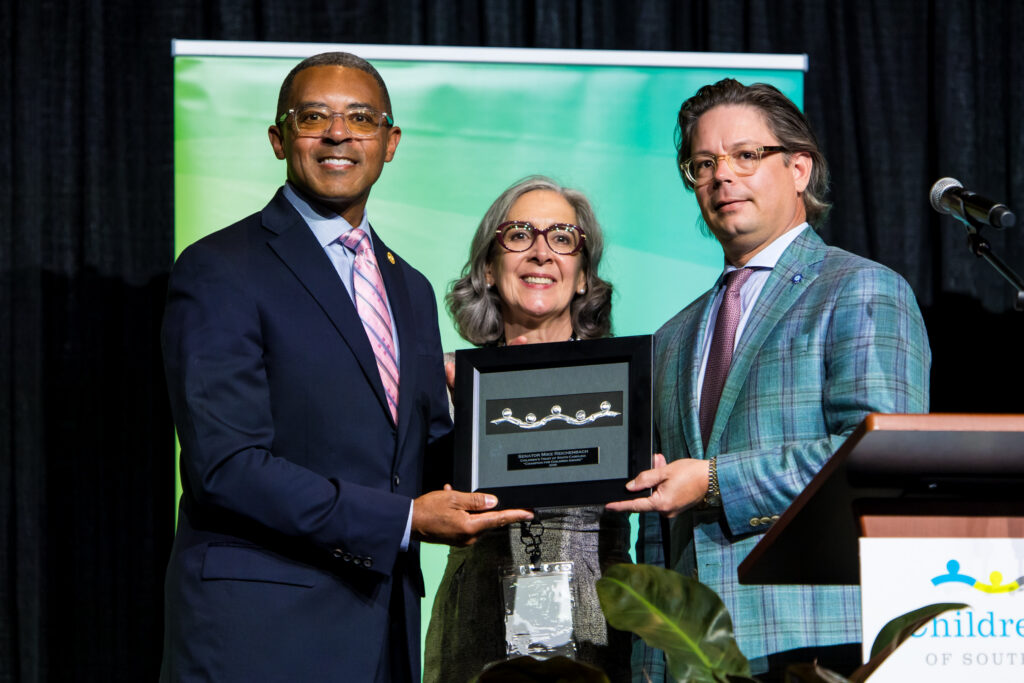
As Children’s Trust Board of Directors chair Philip Vann noted during the presentation, “Senator Reichenbach understands something that so many in this room hold dear: preventing child abuse and neglect isn’t just good policy; it is the foundation for a stronger South Carolina.”
As chair of the Committee on Children, Senator Reichenbach has guided legislation on foster care, kinship care and child safety and has been a vocal proponent of agency and organizational cooperation in creating and sustaining systems that support children and families. This is good and efficient public policy: sustainable, economically effective, and citizen-serving.
His legislative work has helped modernize protections for children in foster and kinship care, lower barriers so relatives can step in for children in need, and raise prevention as a serious, bipartisan priority at the Statehouse.
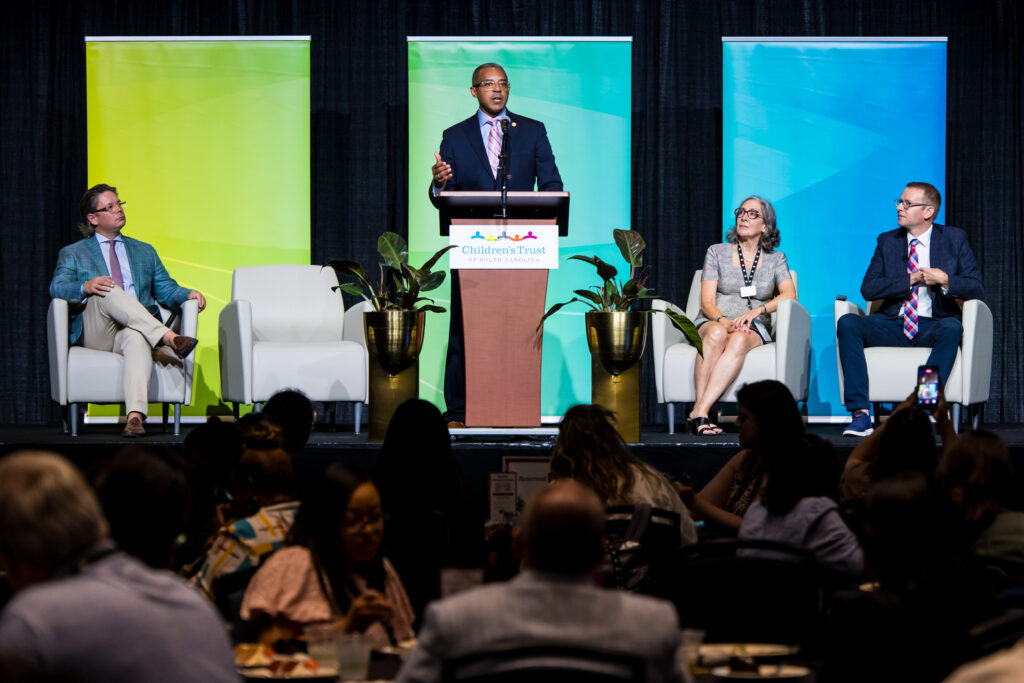
Senator Reichenbach shared his own story upon accepting the award:
“Thank you very much. I am truly humbled by this recognition. I want to thank Children’s Trust of South Carolina for this tremendous honor, and more importantly, for the work you do every day on behalf of children and families across our state. To be recognized as a Champion for Children is especially meaningful to me because this work is deeply personal.
“Many of you know part of my story. My biological mother was only 14 years old when she became pregnant with me. She faced circumstances that no 14-year-old should have to face, and a decision that would ultimately determine the course of my life. She chose life.
“And then she made another extraordinarily difficult decision. She allowed me to be adopted by a family who could give me the stability and opportunities she wanted for me.
“I was blessed to be raised by two wonderful parents, Ed and Shirley Reichenbach. They taught me about faith in God, hard work, discipline, kindness and responsibility. Most importantly, they taught me that family is defined by something much deeper than a bloodline. I have never forgotten that.
“My life could have turned out very differently. And because of that, I have always felt a responsibility to do what I can for children whose circumstances may be difficult, but whose futures are not yet written. That responsibility has followed me throughout my life, as a father, a coach, a law enforcement officer, a businessman, and now as a State Senator and Chairman of the Joint Citizens and Legislative Committee on Children.
“When I became Chairman of the Children’s Committee, I knew I did not want us to begin with the assumption that those of us in Columbia already had all the answers. I wanted us to listen. “So last fall, our committee traveled across South Carolina. We went to Columbia, Florence, Greenville, Charleston, and Aiken.
“We listened to young people. We listened to parents and caregivers. We listened to service providers, educators, advocates, and community leaders.
“They told us about housing instability. They told us about the challenges facing young people leaving foster care. They talked about nutrition, child care, mental health, education, and the difficulty families sometimes have simply finding and accessing the help that is already supposed to be available to them.
“Those conversations matter because good public policy should begin by listening to the people who live with its consequences. Then we have a responsibility to do something with what we hear.
“During the 2025–2026 legislative session, ten bills sponsored or endorsed by the Children’s Committee became law. I am proud of that number. But I am much more interested in what those laws mean for individual children and families.
“One of those measures was S. 823. For a child who has experienced abuse, neglect, removal from a home, termination of parental rights, or adoption, permanency should mean more than a legal change on a piece of paper. It should mean the opportunity to finally feel safe and secure.
“This new law gives our family courts another tool to protect that stability by allowing them to consider whether no contact or supervised contact is appropriate when parental rights are terminated, or an adoption is finalized.
“But I also know that celebrating what we have accomplished cannot become an excuse to stop pushing for what still needs to be done.
“One of those priorities for me is the Fostering Futures Act, legislation I introduced to help young people who have experienced foster care pursue a college education. Think about what we ask of these young people.
“Many have already experienced instability and loss that most of us cannot imagine. Then, as they reach adulthood, we expect them to navigate college applications, tuition, housing, transportation, and all the other challenges of beginning life on their own, often without the family support system that so many of us take for granted.
“The Fostering Futures Act says that if one of these young people has done the hard work to earn a place at one of South Carolina’s public colleges or universities, we should do what we can to help make sure finances are not the reason they cannot walk through that door.
“The proposal would waive tuition for eligible current and former foster youth and help connect them with housing, employment opportunities, and support on campus. This is not about lowering expectations. It is about giving young people who have already overcome tremendous obstacles a fair opportunity to meet them. And I believe South Carolina can do this.
“Because our responsibility to a child cannot end when that child turns 18 or leaves foster care. If we are serious when we tell these young people that their lives have value and their futures matter, then we need to make sure they have a real opportunity to build those futures.
“Our committee has also been looking at ways to better support young people who have experienced foster care, improve access to essential infant products and nutrition, strengthen trauma-informed responses for children who have experienced adversity, and ensure that children have a meaningful voice when decisions are being made about their lives.
“And through all of that work, I keep coming back to something my own life taught me. Circumstances matter. But circumstances do not have to determine a child’s destiny. A child can be born into an incredibly difficult situation and still become a business owner, a husband and father, a law enforcement officer or even a State Senator.
“But children should not have to overcome every obstacle alone. They need families. They need communities. And sometimes they need all of us in this room to make sure the systems intended to serve them actually work. That is why I believe supporting children also means supporting families.
“It means doing everything we reasonably can to keep families safe, healthy, and stable. When that is not possible, it means making sure there is a safe and loving home ready for a child who needs one. And when a child enters foster care or adoption, it means remembering that permanency is not merely a case outcome. It is a child finally knowing, ‘This is my home. These are my people. I belong here.’
“That is why the work represented at this conference is so important. And it is also why I accept this award, knowing there is much more work ahead.
“Our committee recently released its 2026 Data Reference Book, which shows progress in some areas. Child deaths have declined. Juvenile delinquency referrals have declined. The number of children served in foster care continues to decline.
But other numbers remind us how urgent our work remains. Thirty-six South Carolina children died by suicide in 2025. More than 17,000 students in our schools were identified as homeless. Behind every one of those numbers is a child. Behind every child is a story. And we have a responsibility to listen to those stories.
“In the coming weeks, the Children’s Committee will once again travel across South Carolina for our public hearings. We will once again ask families, young people, caregivers, advocates, and communities to tell us what is working, what is not working, and what we can do better. Then we will take what we hear back to the State House and get to work.
“I am grateful to my fellow members of the Joint Citizens and Legislative Committee on Children, to our staff, to our agency partners, and to the advocates and organizations across South Carolina who bring their knowledge and experience to this work. And I am especially grateful to the children and families who have trusted us with their stories. That trust carries a responsibility.
“Finally, thank you to Children’s Trust for this award and for your commitment to preventing child abuse, strengthening families, and giving children the opportunity to thrive. I am honored to receive the Champion for Children Award.
“But the greatest honor will be what all of us do with the opportunity we have been given to serve. My parents taught me that to whom much is given, much is required. I have been given much.
“And as long as I have the opportunity to serve, I will keep working to make sure that every child in South Carolina has what every child deserves: a safe home, a strong family, people who believe in them, and the opportunity to build a future filled with hope.
“Thank you, and God bless you.”